

3 Essential Website Audits to Ensure Your Business Gets Cited by AI
As modern AI search engines like ChatGPT, Google Gemini, and Perplexity become the primary gateways to the internet, how customers discover your business is undergoing a fundamental shift. Traditional SEO focused on earning a top spot on a list of blue links; AI search focuses on positioning your brand as the definitive, cited answer.
When potential customers ask an AI engine for vendor recommendations in your field, will your company be highlighted, or will AI engines overlook your site for a competitor whose information is easier to process?
To ensure AI systems can accurately read, interpret, and cite your content, your business needs an AI readiness audit. This evaluation relies on three fundamental structural pillars designed to turn your website into a trusted resource for AI platforms.
The Three Pillars of an AI Readiness Audit
Before declaring your website ready for the AI era, evaluate your platform across three essential structural layers:
|
Pillar |
Focus |
What It Does |
|---|---|---|
|
Pillar 1: Schema Markup |
Digital Verification |
Tells AI what your content actually means, rather than making it infer context. |
|
Pillar 2: Content Structure |
Clean Organization |
Using labelled data points, AI can process instantly instead of hiding facts in long paragraphs. |
|
Pillar 3: Internal Linking |
Smart Connections |
Shows AI how your services, team, and client results interlock across your site. |
Pillar 1: Audit Your Schema Markup (Providing Direct Context)
Think of schema markup as a digital business card built into your website's code. While visitors see formatted pages, AI models read underlying metadata to verify who you are, what services you offer, and who runs the business.
Without explicit schema markup, an AI engine has to guess your business details. For example, it might struggle to determine whether a company named "NexaLine Innovations" is a software company, a corporate accounting group, or a recruitment firm.
Core Schema Types for Business Websites
To make your site effortlessly readable to AI, prioritize these core schema implementations:
|
Schema Type |
Where It Belongs |
What It Tells AI |
|---|---|---|
|
Organization |
Homepage, About Us page |
Official company name, logo, direct contact info, and primary service categories. |
|
Article or Blog Posting |
Blog posts, case studies, news updates |
Topic focus, original publication date, and verified author information. |
|
Breadcrumb |
Pages with sub-categories or navigation paths |
Where the specific page sits within your site hierarchy. |
|
Person |
Team pages, author bio boxes |
The actual specialists behind your content, including titles and credentials. |
Pillar 2: Audit Your Content Structure (Eliminating Unformatted Text)
Imagine opening a critical business email where the price, service details, client requirements, and team qualifications are all compressed into one dense paragraph. Extracting specific facts would take unnecessary effort.
AI engines encounter the same friction when reading poorly structured web content.
Comparing Unstructured vs Structured Data
When information is packed into a single text block, AI engines are forced to estimate what each phrase represents. Structuring content with clear headers, concise lists, and categorized data fields allows AI tools to pull exact details instantly.
For Example:
-
AI doesn't need to estimate key details like pricing, eligibility, or scope.
-
Key information can be pulled directly into search summaries when prospective users ask specific questions.
Pillar 3: Audit Your Internal Linking (Building Your Knowledge Network)
AI tools interpret expertise by evaluating how topics relate to one another. If your web pages operate in isolation, AI platforms cannot easily recognize how your core services, expert staff, and client success stories align.
Strategic internal links serve as the connective network for these elements across your website.
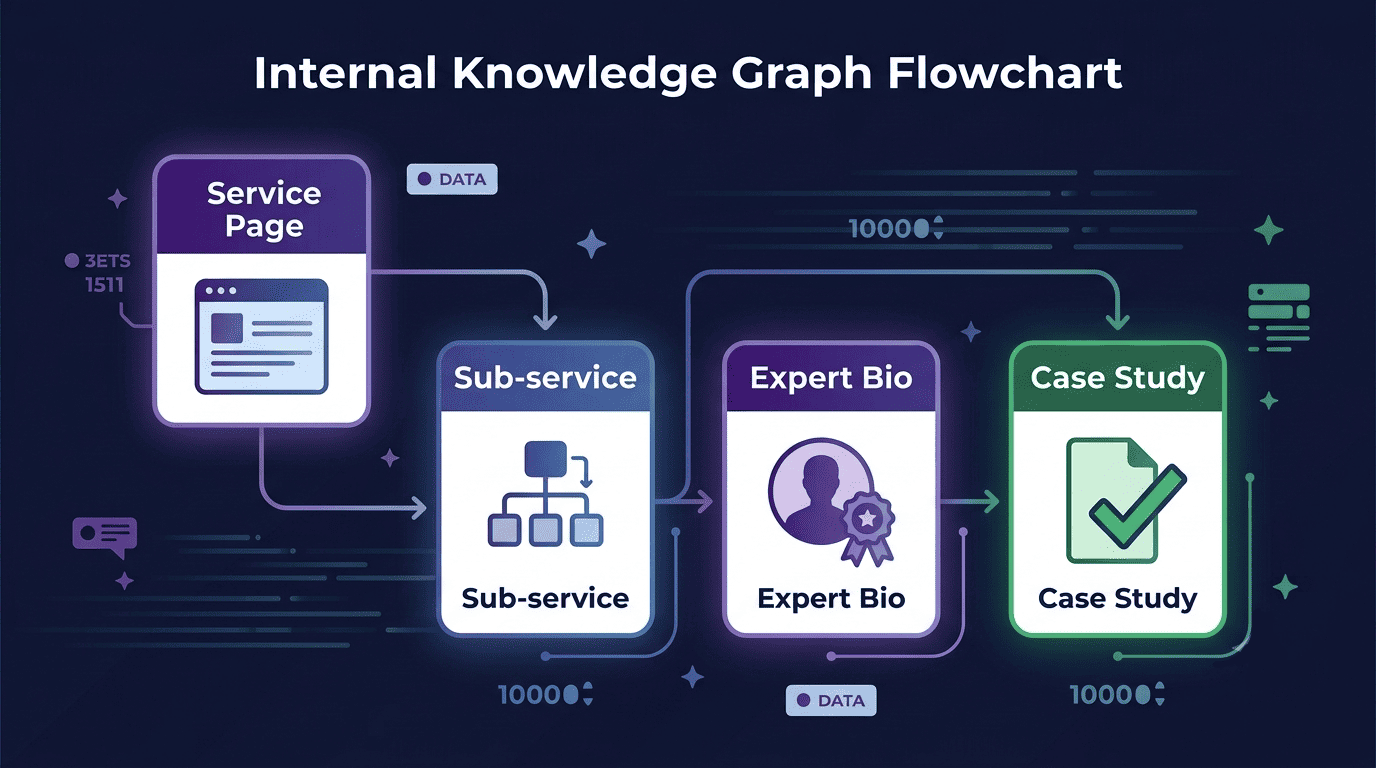
Practical Mapping: Connecting Your Services to Expertise
Here is how a commercial service business should map content connections:
Primary Service Page
Corporate IT Services
Managed Cybersecurity
Specialized Sub-Service
Specialist Bio
David Miller, CTO
Cyber Attack Prevention Results
Case Study
-
The Core Page (e.g., Corporate IT Services) links directly to specific service offerings (e.g., Managed Cybersecurity).
-
The Specialized Service Page links to the internal lead specialist managing that service (e.g., "David Miller, CTO").
-
The Specialized Service Page links back to verified client case studies and performance outcomes led by that expert.
This interconnected setup forms a distinct knowledge network on your site. When a user asks an AI search engine, "Which IT firm offers proven cybersecurity support led by certified experts?" the AI can confidently cite your business because it sees the verified connections between your offerings, your team's credentials, and your proven results.
Prepare Your Website for the Age of AI Search
Ensuring your website is ready for AI search doesn't require rebuilding your online presence from scratch. By focusing on these three pillars, implementing clean schema markup, organizing key facts clearly, and establishing logical internal connections, you position your business to be easily read, verified, and cited across modern AI platforms.
Ready to Ensure Your Site Is AI-Ready?
If you want to evaluate your website's visibility and secure your brand's presence in AI search results, our team is here to assist. We will analyze your site structure, audit your schema, and deliver a tailored optimization strategy tailored to your industry goals.
👉 Request an AI Readiness Audit with the W3Rider Team